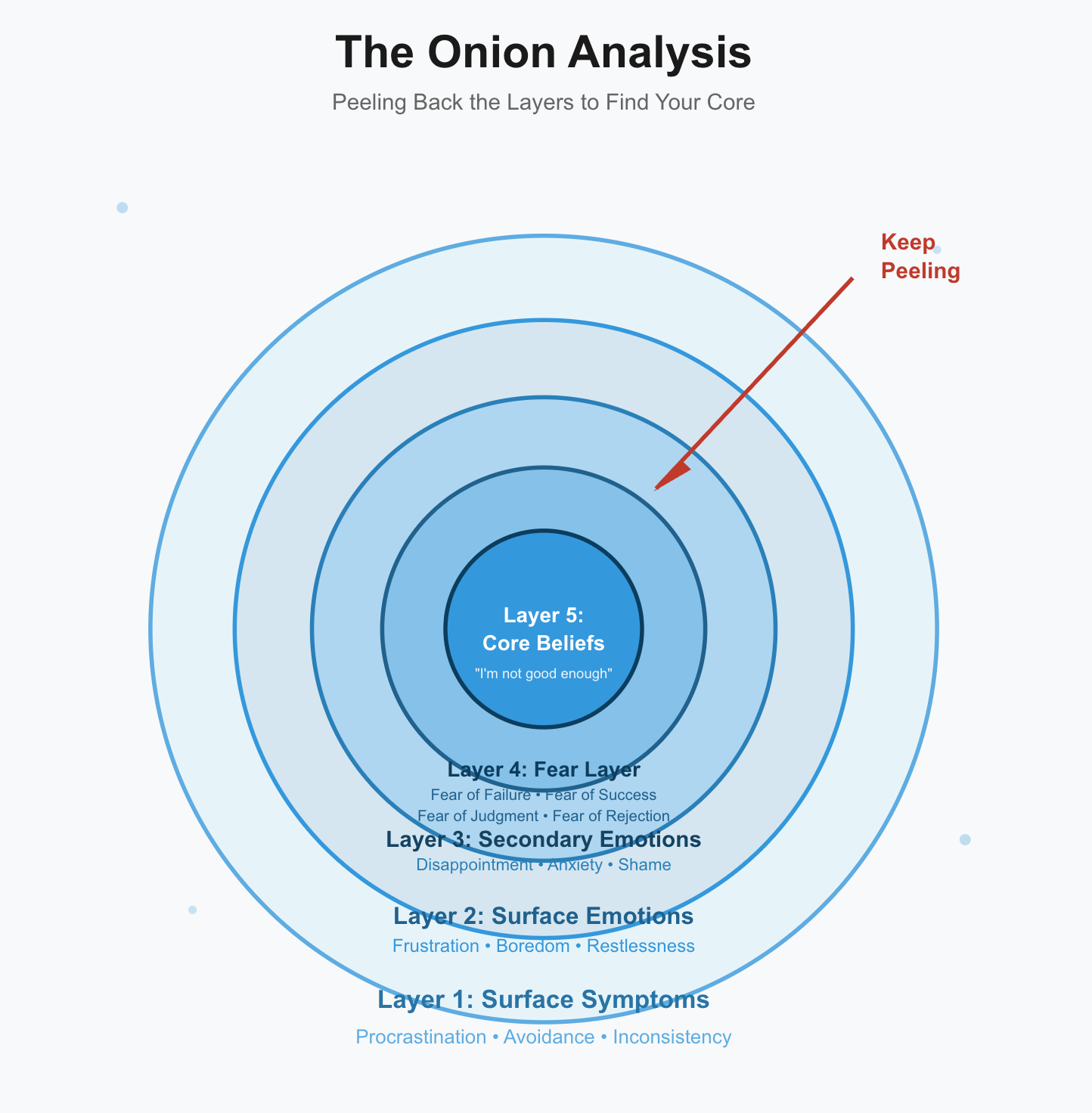
The Onion Analysis
Marinus C. Leach January 19, 2026
Marinus C. Leach January 19, 2026
reading time approx 8-9 minutes
You know what you need to do. You've read the books, taken the courses, hired the coach. You have the strategy, the systems, the step-by-step plan. And yet... you're not doing it.
Maybe you're procrastinating on launching that new offer. Maybe you can't seem to stay consistent with your marketing. Maybe you keep undercharging, overpromising, or playing small even though you know better.
Here's the truth most business advice won't tell you: Your surface problem isn't your real problem.
Think of your challenges like an onion. What you see on the surface—the procrastination, the inconsistency, the self-sabotage—is just the outer layer. Underneath are deeper layers of emotions, fears, and ultimately, core beliefs about yourself that are running the show.
Most entrepreneurs spend their entire careers treating symptoms while the real issue remains untouched at the center. They read another productivity book when the real problem is a deep-seated fear of success. They hire another marketing consultant when the real issue is a belief that they're not interesting enough to be seen.
You can't hack your way past a core wound.
Let me show you how this works.
This is where most people stop. It's the observable behavior:
These symptoms are real, but they're not the problem. They're the messenger telling you something deeper needs attention.
When you pause and actually check in with yourself, you notice feelings:
These emotions are valid, but they're still just pointing you deeper. Keep peeling.
If you sit with those surface emotions instead of immediately trying to fix them, other feelings emerge:
Now we're getting somewhere. This layer is painful, which is why most people don't go here. But we're not done yet.
Underneath the emotions are specific fears driving everything:
These fears feel very real and immediate. They're the reason your nervous system keeps you stuck. But there's still one more layer.
At the very center are the fundamental beliefs you hold about yourself:
This is where the work happens.
Surface: Sarah has been "working on" her group coaching program for six months but hasn't launched.
Surface Emotion: Frustrated with herself for the delay.
Deeper Feeling: Anxious about it not being perfect yet. Embarrassed she keeps telling people "it's coming soon."
Fear: Afraid people will criticize it. Afraid it will fail publicly and prove she's not cut out for this.
Core Belief: "If I fail, it means I'm not capable. My worth depends on succeeding."
Once Sarah identified this core belief, everything clicked. She wasn't struggling with time management or needing a better launch strategy. She was protecting herself from feeling worthless. No amount of strategy could fix that. She needed to address her conditional self-worth.
Surface: Marcus consistently prices 30-40% below market rate.
Surface Emotion: Uncomfortable when thinking about raising prices.
Deeper Feeling: Guilt about asking for more money. Anxiety about how clients will react.
Fear: Afraid clients will leave. Afraid he won't deliver enough value to justify higher prices.
Core Belief: "I'm not worth what successful people charge. I'm an imposter."
Marcus could read pricing strategies all day, but until he addressed his imposter syndrome and worked on believing in his own value, he'd keep undercharging. The pricing wasn't a business problem—it was a self-worth problem.
Surface: Jessica starts strong with content creation, then disappears for weeks or months.
Surface Emotion: Bored with posting. Feels like it's not working anyway.
Deeper Feeling: Disappointed in her engagement levels. Feeling invisible and irrelevant.
Fear: Afraid of being seen and judged. Also afraid of being completely ignored.
Core Belief: "I'm not interesting enough. People don't really care what I have to say."
Jessica didn't need another content calendar or a different social media platform. She needed to heal the belief that she wasn't interesting or valuable enough to be heard.
This isn't comfortable work. That's why most people avoid it. But if you're serious about breaking through your patterns, here's how to do it:
What keeps happening? Where do you consistently self-sabotage or avoid? Be specific and honest.
Don't rush through these. Journal on each one:
Each layer brings discomfort. Your instinct will be to fix it, strategize around it, or numb it with Netflix and scrolling. Don't. Let yourself actually feel it.
The discomfort is information. It's showing you what needs healing.
Core beliefs usually formed somewhere in your past—childhood experiences, early failures, family messages, or traumatic moments. When you identify where you first learned this belief, you can begin to see it's not absolute truth. It's just a story you've been telling yourself.
Now you can do the real work:
Here's what I've learned working with hundreds of entrepreneurs: Surface solutions create temporary change. Core work creates transformation.
You can't discipline your way past a belief that you're not enough.
You can't time-manage your way past a fear of being seen.
You can't strategy your way past the terror of succeeding.
All those books, courses, and tactics you've tried? They bounce off the surface of the onion. They might create a burst of motivation or a few weeks of new habits, but then you're back to the same pattern because the core belief is still running the show.
When you do the hard work of getting to the center of your onion, everything changes:
So here's what I want you to ask yourself: What pattern keeps showing up in your business, no matter how many strategies you try?
That's your invitation to start peeling.
The most successful entrepreneurs aren't the ones who never had limiting beliefs. They're the ones who had the courage to peel back the layers, sit with the discomfort, and do the deeper work of healing what was at the core.
Your business challenge isn't what you think it is.
It's time to peel the onion.
What layer are you stuck on? What would change if you finally addressed the core belief driving your patterns? The answers might be uncomfortable, but they're also the key to everything you've been trying to build.
Stay up to date on the latest real estate trends.

Outdoor activities Raleigh NC

Two Tech Markets. One Clear Investment Advantage.
Why Your Business Problems Run Deeper Than You Think

Your Blueprint for Real Estate Success

December 2025 Market Analysis & First Quarter 2026 Outlook

Must-Have Looks You’ll Love

A Considered Approach to Christmas Real Estate

Why 2026 Could Be Homebuyers' Year

Up to $80,000 in down payment help through state and local programs
Whether we are preparing a home to sell or negotiating a contract to close, we ensure that our clients are informed and involved, no matter where they are in the world. Contact us today!