Austin VS Raleigh
Marinus C. Leach February 21, 2026
Marinus C. Leach February 21, 2026
For years, when investors started chasing tech-driven growth in the Sun Belt, two markets kept coming up: Austin and Raleigh. Both climbed fast — population growth, job expansion, national attention, lifestyle appeal. On paper, they check all the boxes.
But popularity isn’t the same as profitability.
When I’m deploying capital — or advising someone who is — the question isn’t which city is trending. It’s which market produces stronger fundamentals, healthier risk-adjusted returns, and a more sustainable long-term outlook.
Growth headlines are great. Rankings are great. “Cool factor” doesn’t pay the mortgage.
If you’re allocating serious capital, the real conversation is about durability of demand, cost structure, yield compression, tax exposure, and long-term total return. That’s how you determine which market actually gives you the better investment — not just the louder story.
We aren't looking for the better place to live—we are looking for the strongest financial returns. So, let’s answer the million-dollar question right upfront: Austin vs. Raleigh: Which Tech Hub Offers Stronger Real Estate Returns?
The short answer, based on current affordability and market maturity, is that Raleigh, NC, currently offers a more sustainable and less volatile path to long-term returns, while Austin, TX, remains the higher-risk, higher-reward play that requires far more precise timing.
I’ve been tracking the incredible shifts in these competitive markets for over a decade, and what I’ve seen recently suggests that the rules have changed. Austin’s massive run-up has created hurdles, while Raleigh’s measured, diversified growth keeps making it an investor darling. Let’s dive deep into the specific dynamics that make these two cities fundamentally different when it comes to stacking up profit.
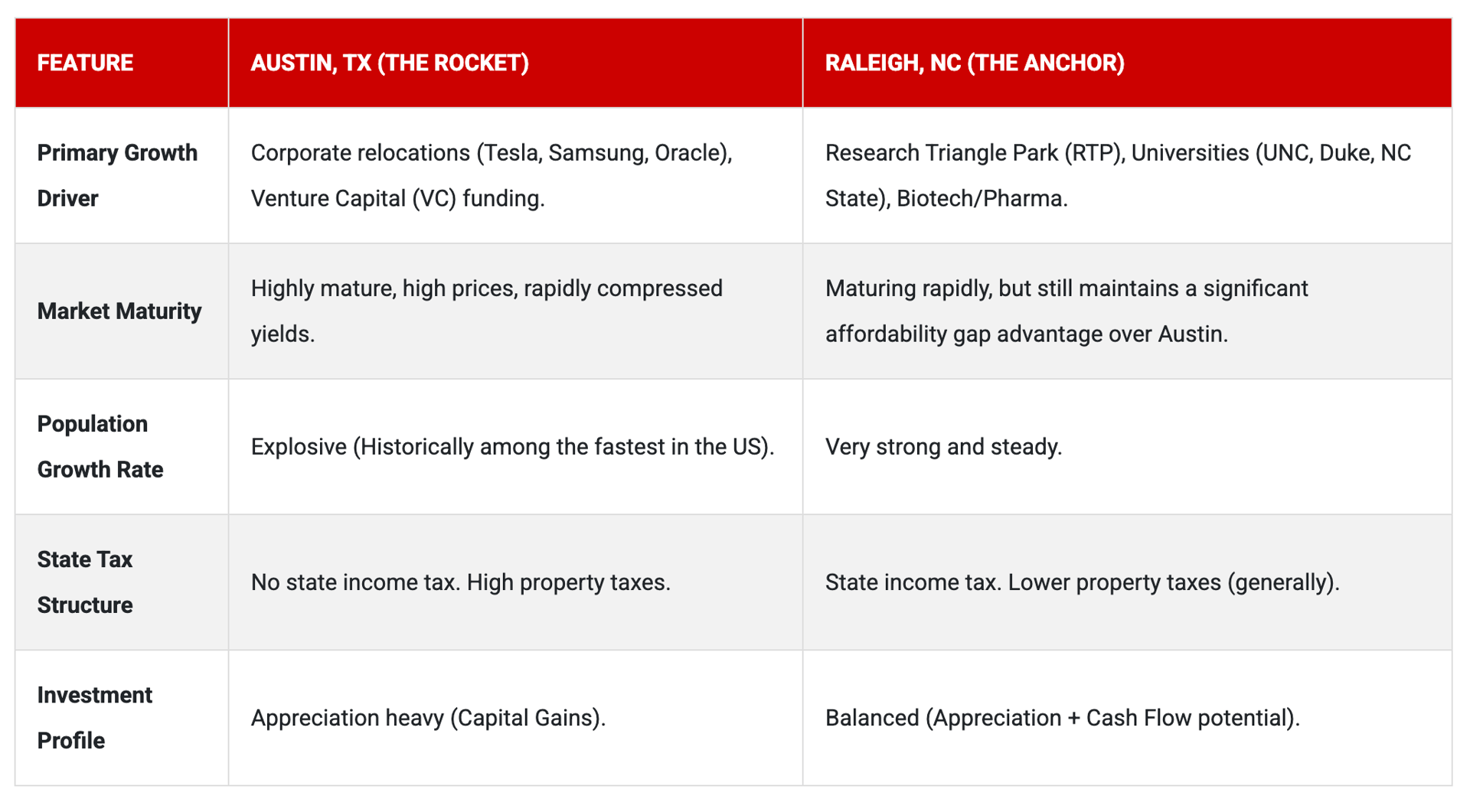
When we look at both metros, we are analyzing two distinct styles of economic development. Austin is the flashy newcomer; Raleigh is the quiet anchor.
When I think about investing in Austin, I think about momentum. For years, it felt like Austin couldn’t miss. It became the go-to destination for tech talent leaving California, and that demand pushed values up at an aggressive pace.
But momentum cuts both ways.
The Volatility Conversation
In real estate, rapid growth usually comes with increased risk. We watched Austin median prices jump nearly 40% in a single year during the pandemic run-up. That kind of acceleration is exciting — but it also builds fragility into the market.
When rates rise or the tech sector slows, markets that expanded that quickly tend to correct faster and harder. My view is that Austin’s trajectory has been heavily influenced by VC cycles, major corporate relocations, and concentrated tech expansion. When that engine pauses, the deceleration is noticeable.
That’s volatility. And volatility matters when you’re underwriting long-term holds.
The Property Tax Reality
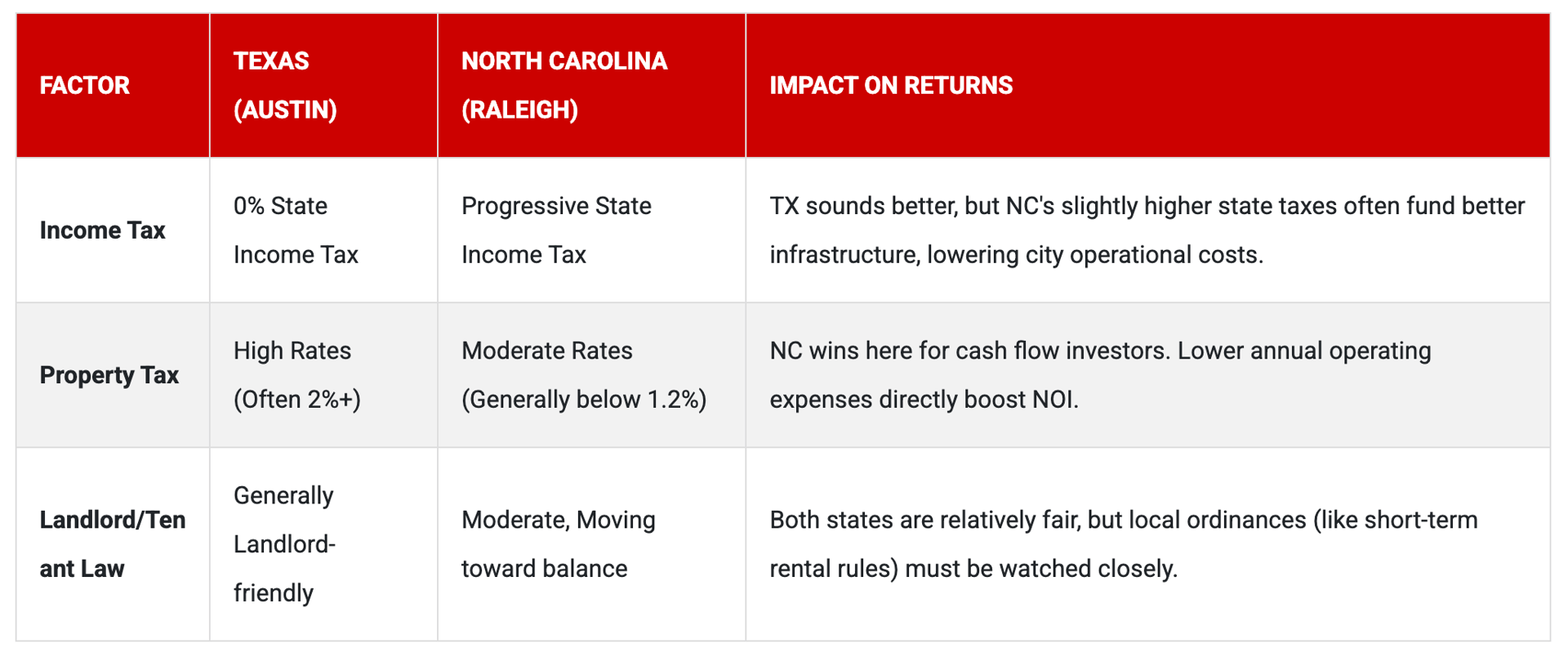
Then there’s the property tax structure. Texas promotes zero state income tax, but that revenue has to be replaced somewhere — and it shows up at the local level.
For buy-and-hold investors focused on cash flow, this is critical. As property values increase, your tax burden rises with them. That directly compresses your Net Operating Income. In other Texas metros like Dallas or Houston, stronger rent-to-value ratios can offset that pressure. In prime Austin, that cushion is thinner.
What ends up happening? Many investors are effectively relying on appreciation to justify the deal. The rental income often just covers operating expenses and debt service. That’s not a cash-flow-driven investment — that’s an appreciation bet.
And appreciation-only strategies leave very little room for error.
From a risk-adjusted perspective, I prefer markets where income and appreciation work together — not markets where you’re depending entirely on future price growth to make the numbers work.
Now let’s look east to Raleigh, the anchor of the Research Triangle Park (RTP), which includes Durham and Chapel Hill. Raleigh is not a new contender, but it didn't get the same blinding media spotlight as Austin, and that’s a good thing for investors.
The Power of Diversification
The key to Raleigh’s resilience is its foundation. Where Austin relies heavily on IT and venture-backed startups, Raleigh’s economy is built upon three pillars:
When the 2022 market slowdown hit, Raleigh felt the cooling effects, but its descent was far more gentle and controlled than Austin’s sharp drop. Why? Because the job market didn't panic. The pharmaceutical companies still needed scientists, and the universities still needed staff. This translates directly into more stable housing demand.
Both markets attract strong talent — that’s not the debate. The nuance is cost of talent and what that means for long-term housing demand.
Raleigh has become extremely attractive to tech companies because of wage arbitrage. Firms can hire high-quality engineers in the Triangle at 15–20% less than Austin — and dramatically less than Silicon Valley — without sacrificing skill level. That delta matters at scale. It allows companies to expand teams without crushing payroll overhead, which keeps job growth steady and sustainable.
And steady job growth equals steady rental demand.
When the talent pipeline is strong and cost-efficient, you get a durable renter base — professionals relocating for stable, long-term roles rather than short-term speculative growth cycles. That stability supports occupancy and reduces volatility in rental performance.
Where It Really Shows Up: Cash Flow
Let’s simplify this and make it practical.
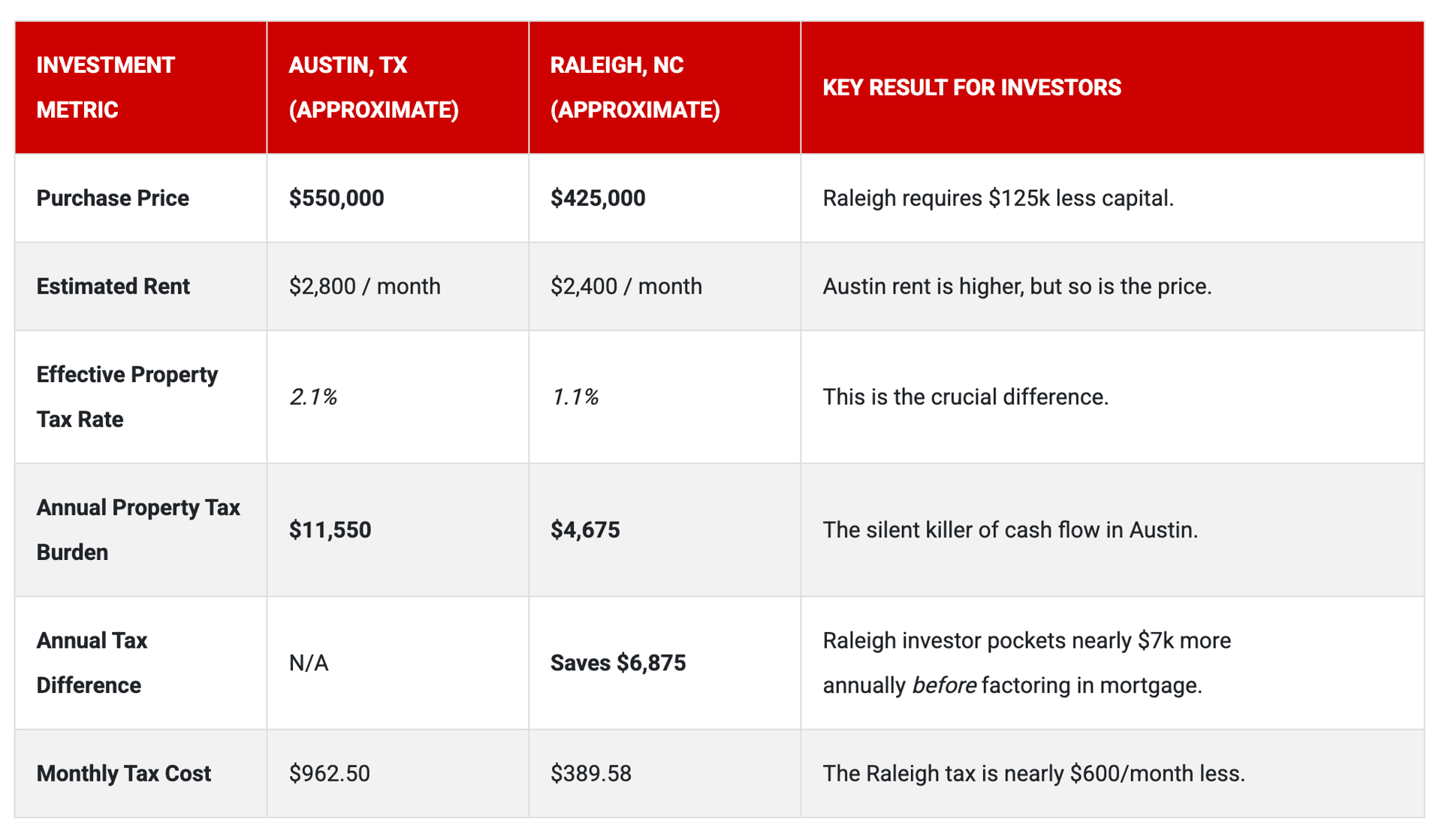
When you compare two similar rental properties — one in a strong Austin submarket and one in a desirable Raleigh submarket — the biggest differentiator for a buy-and-hold investor isn’t hype. It’s ownership cost.
Specifically: property taxes.
Texas property taxes materially impact Net Operating Income (NOI). Even if gross rents look competitive, higher taxes eat into your annual yield. That compression directly affects your cash flow and overall return profile.
If you strip it down to price and property tax differences alone, the annual cash flow variance becomes meaningful. And over a five- to ten-year hold, that delta compounds.
This is where fundamentals matter. Appreciation is great. Growth narratives are exciting. But when you analyze the numbers line by line, Raleigh tends to offer a more balanced cost structure — which translates into stronger NOI and healthier long-term cash flow positioning for disciplined investors.
When I evaluate a market, I’m not just looking at appreciation. I’m looking at total return — appreciation plus cash flow. If you’re only winning one way, you’re exposed.
Austin’s Compressed Yields
Austin saw aggressive price appreciation, and that run-up compressed cap rates significantly. When values outpace rents, your yield tightens. In many cases, rent barely offsets the mortgage, insurance, and those elevated Texas property taxes. At that point, you’re not investing for income — you’re speculating on future appreciation. Your entire return hinges on resale value five years down the road. That’s a thin margin strategy.
Raleigh isn’t immune to cap rate compression, but overall, the spreads are healthier — particularly in submarkets around RTP like Cary, Apex, and Durham. In many scenarios, you can still structure a deal that produces modest but consistent positive cash flow. That cash flow becomes your downside protection. It gives you breathing room if appreciation slows.
I always tell investors: position yourself to win two ways. Let appreciation build long-term equity while cash flow protects you in the short term. Raleigh gives you a more realistic opportunity to execute that dual strategy without relying purely on future price growth.
Stay up to date on the latest real estate trends.

Outdoor activities Raleigh NC
Two Tech Markets. One Clear Investment Advantage.

Why Your Business Problems Run Deeper Than You Think

Your Blueprint for Real Estate Success

December 2025 Market Analysis & First Quarter 2026 Outlook

Must-Have Looks You’ll Love

A Considered Approach to Christmas Real Estate
Why 2026 Could Be Homebuyers' Year

Up to $80,000 in down payment help through state and local programs
Whether we are preparing a home to sell or negotiating a contract to close, we ensure that our clients are informed and involved, no matter where they are in the world. Contact us today!